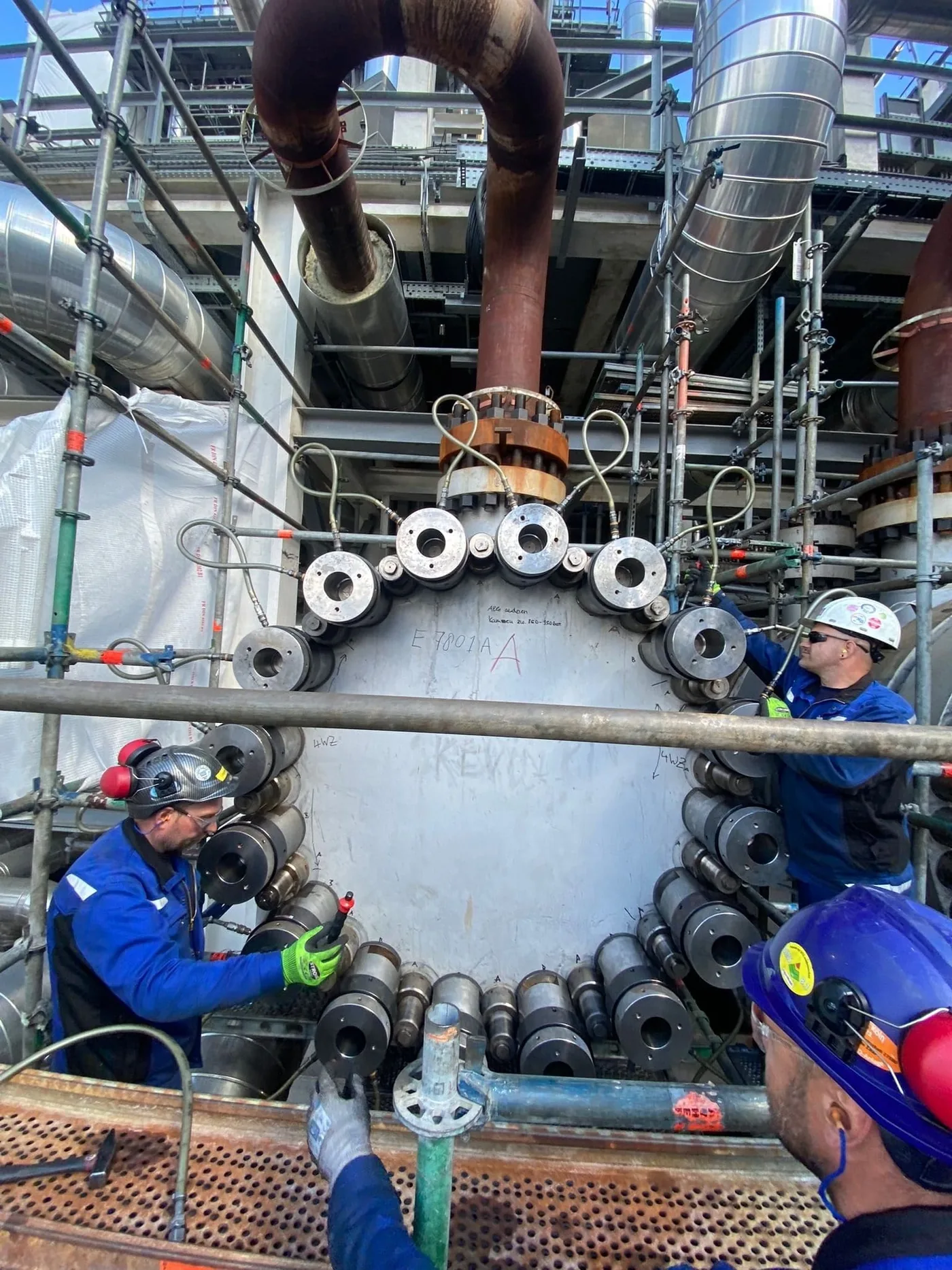
What is controlled bolting / bolt tensioning?
Controlled bolting means: every bolt of a flange connection receives a calculated, documented preload — instead of being tightened "by feel". This matters, because the majority of all flange leaks are caused by assembly errors. HSOS uses two methods: hydraulic torque wrenches and hydraulic tensioning with stud tensioners. In tensioning, the bolt is stretched axially and the nut is run down load-free — no friction losses, no torsion in the bolt. The result: preload scatter of typically ±5–10% instead of ±25–30% with uncontrolled torquing.
Scope of service
- ▸Hydraulic torque tightening: square-drive and low-profile cassette wrenches, 700 bar pump technology
- ▸Bolt tensioning: simultaneous tensioning of several bolts (50% or 100% coverage) for uniform gasket compression
- ▸Bolt-load calculation to ASME PCC-1 or EN 1591-1
- ▸Ultrasonic preload measurement (time-of-flight measurement of bolt elongation)
- ▸Flange management: joint numbering/tag system, flange report per joint, calibration certificates, leak follow-up at start-up
- ▸Rental of torque and tensioning equipment (see "Rental" page)
- ▸Training WFPr and WFPr TT in accordance with VCA-SOG (see "Training" page)
Torque or tensioning — which is right when?
| Criterion | Hydraulic torque wrench | Bolt tensioning |
|---|---|---|
| Working principle | nut is rotated with a defined torque; preload is created via the thread | tensioner stretches the bolt axially; nut is run down load-free |
| Preload scatter | uncontrolled above ±25%; ±15% achievable with qualified personnel, defined lubrication and tightening pattern | typically ±10%, down to ±5% under good conditions |
| Influencing factors | friction (up to ~90% of the torque), lubricant, surface condition | largely independent of friction |
| Typical use | standard flanges, restricted access (cassette) | critical high-pressure/heat-exchanger flanges, large bolt diameters, simultaneous tensioning |
Standards & qualification
- ▸DIN EN 1591-4: all HSOS fitters hold the basic bolting qualification to DIN EN 1591-4 (qualification of personnel assembling bolted joints in pressurised systems, valid 5 years)
- ▸ASME PCC-1 (2022 edition): staged tightening patterns, lubrication, contact surface inspection — basis of our assembly procedure
- ▸WFPr / WFPr TT (SSVV/VCA-SOG): personnel qualification required in the Dutch and Belgian petrochemical industry, valid 10 years — HSOS staff are qualified; training also offered to customer personnel
- ▸Company certified to ISO 9001:2015, ISO 45001:2018, VCA-P 2017/6.0
Typical applications
- ▸Refinery/petrochemical turnaround: tagged flanges are opened, assembled and tightened to plan — every joint with a report. Depending on shutdown size, typically 15–35 flanges by bolt tensioning and 45 to over 100 joints by torque tightening.
- ▸Heat exchangers: simultaneous tensioning of the tube-sheet bolting for uniform gasket compression.
- ▸Reference, gas scrubbers: controlled bolting of three vessel flange connections — 1¾″ bolts, 4,800 Nm.
- ▸Reference, HP feedwater heater: torque tightening with M72 bolts, 10,200 Nm.
Why HSOS?
Highest accuracy and uniformity for critical, high-pressure connections — with calculation, calibrated equipment and complete documentation per joint. Combinable with flange facing (when the flange needs repair first) and as a complete package during turnarounds.
Across-flats size and thread pitch for metric bolts per DIN EN ISO 4014/4017 and DIN 931 — plus why tightening torque is calculated per joint.
View chart →Frequently Asked Questions
What is the difference between bolt tensioning and torque tightening?
In torque-controlled tightening of bolted connections the nut is rotated — however, a large part of the applied energy is lost to friction, so the preload scatters uncontrolled by approx. ±25–30%. In bolt tensioning, the preload is created by hydraulic, axial stretching of the bolt while the nut is run down load-free: there are no friction losses, and the specified load is applied to the bolted connection with a scatter of only approx. ±5–10%. Field of application: critical high-pressure bolted connections.
Do you offer flange management (WFPr) training?
Yes — training courses in accordance with the VCA-SOG guidelines: flange fitter to WFPr and working with torque and tensioning tools (WFPr TT) — the qualification required in the Dutch and Belgian petrochemical industry.
Can bolting equipment be rented instead of bought?
Yes — hydraulic torque wrenches, torque tools, pumps and tensioners are available from our rental portfolio on request. On request with instruction or with an HSOS operator.