What is on-site CNC machining?
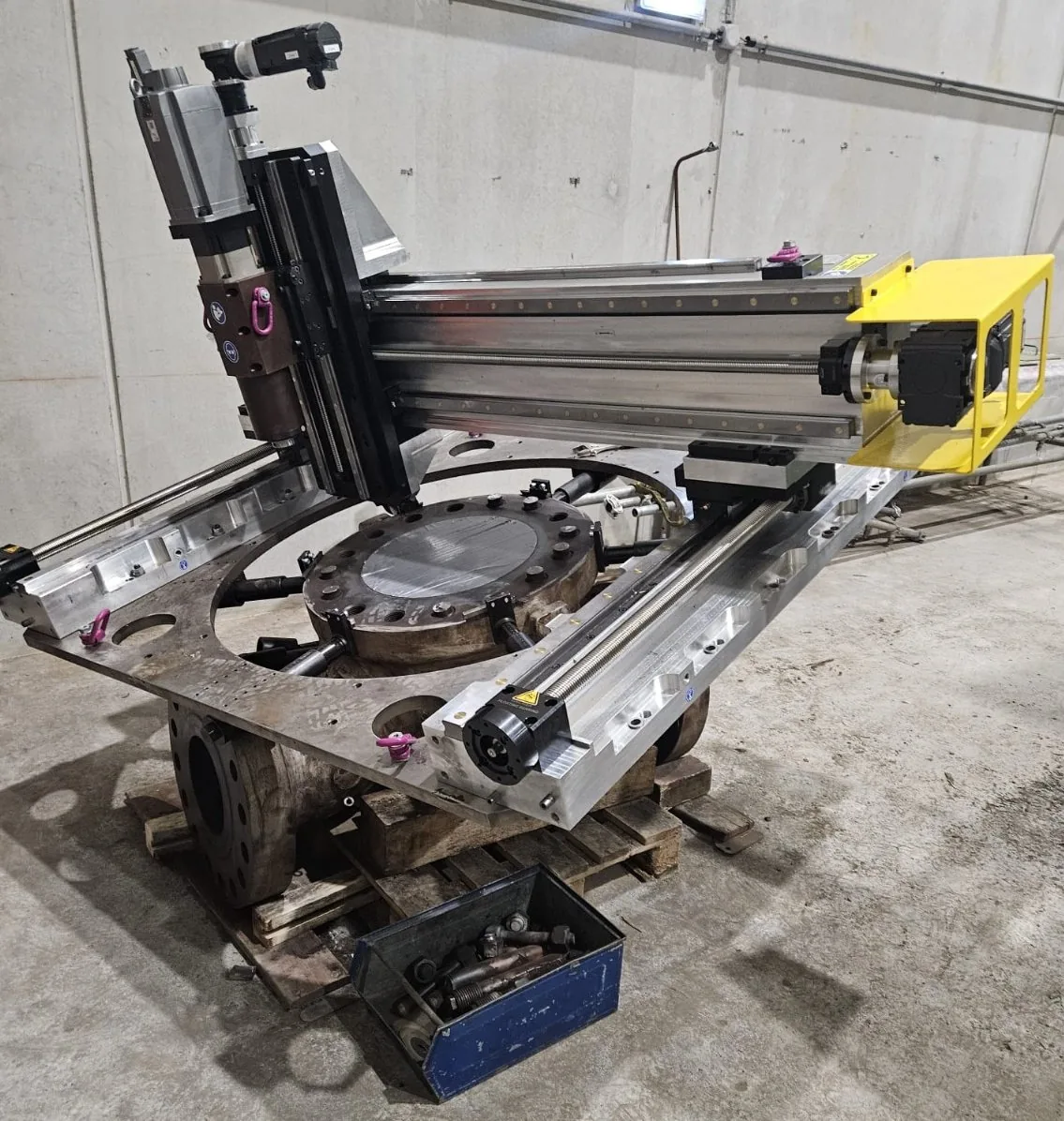
When heavy plant components such as turbines, engine blocks or pressure vessels show wear or damage, repair demands the highest dimensional accuracy. On-site CNC machining means: instead of removing a component weighing several tonnes and transporting it to a workshop, we mount the machine tool directly on the component — on the turbine housing, on the flange, in the machine foundation. Portable milling, turning and drilling units with pneumatic, hydraulic or electric drives machine large components in their installed position — to the millimetre and with the repeatability of modern CNC technology. For operators of refineries, chemical plants and power stations this means: no dismantling, no transport, no weeks of lost production.
Scope of service — these operations are performed on site
- ▸Mobile face milling: perfectly flat, machine-guided machining of turbine split lines, engine foundations, heat-exchanger tube sheets and large flange connections
- ▸Sealing faces by CNC/milling where the method requires it — conventional flange facing (turning of gasket faces) is carried out by our flange facing team with portable lathes (see "On-site flange facing" page)
- ▸Line boring: bearing bores and shaft seats restored to original size (see "Line Boring" page)
- ▸Precision bolt removal and spark erosion: seized or broken studs removed non-destructively — with the original thread fully preserved
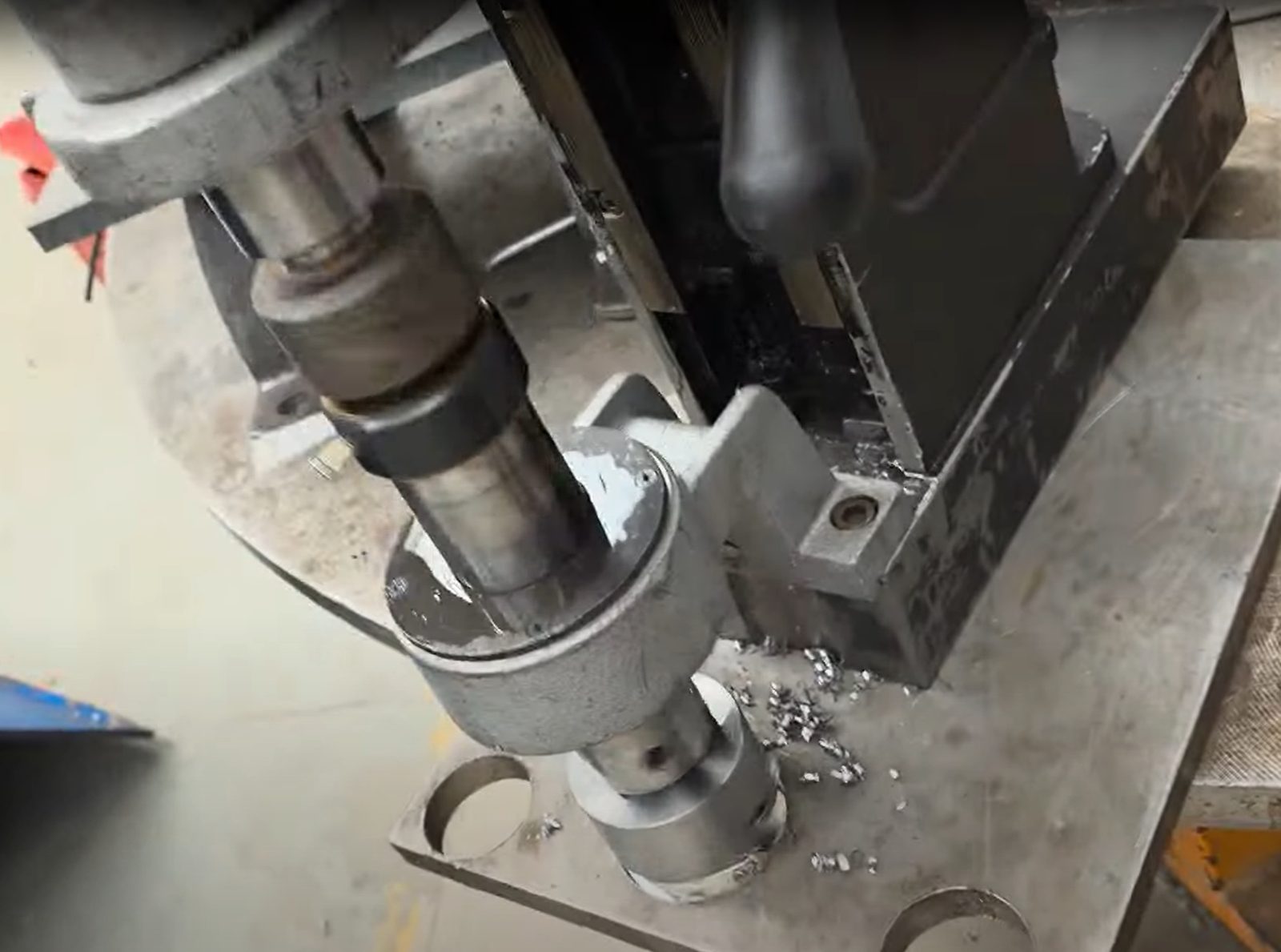
- ▸Drilling and thread milling: magnetic drills, threads in all common sizes and pitches — including hard-to-machine materials
- ▸Contour milling of complex 2D and 3D geometries, grooves and mating faces; cylinder-liner repair
- ▸In-house CNC manufacturing of custom and spare parts at our Wetter workshop — fast and precisely fitting, when making a part is quicker than sourcing it
Technical data
| Parameter | Value |
|---|---|
| Pipe cutting/bevelling (split-frame) | 1″ – 110″ (approx. 25 – 2,800 mm) |
| Line boring | run-out 0.01 – 0.3 mm; fit dimensions ±0.02 mm — depending on diameter and required fit |
| Flatness in face milling | a few hundredths of a millimetre, depending on machine and set-up; 0.02 – 0.4 mm on extremely large diameters |
| Drives | pneumatic, hydraulic, electric (230 V site transformer standard) |
| Machine fleet (extract) | milling/machining units gantry TFM 3500, TGM250, MSF 1200, MSF 1600; Trav-L-Cutter from 6″, various pipe cutters and OD-clamped machines; magnetic drills (flange facing/turning of gasket faces: see "On-site flange facing" page) |
Standards & qualification
Machining is carried out to customer specification or drawing; results are measured and documented. The company is certified to ISO 9001:2015, ISO 45001:2018 and VCA-P 2017/6.0. Cold machining creates no ignition source — important for work in Ex areas of the petrochemical industry.
Typical applications
- ▸Refinery turnaround: heat-exchanger tube sheets and mating faces are milled during the shutdown — in parallel with the HSOS bolting and heat-treatment teams.
- ▸Power plant: face milling a turbine split line in place — the rotor stays where it is.
- ▸Heavy industry: broken studs in a press frame are milled out on site, the thread is preserved.
Why HSOS?
Massively reduced downtime: the lengthy removal and reinstallation of plant components is eliminated, and your machines are back in operation much sooner. No transport or logistics costs for heavy haulage to external machining centres — and no risk of transport damage to sensitive components. A Europe-wide team, reachable 24/7, with in-house CNC manufacturing of custom parts; during turnarounds combinable with flange facing, bolting and heat treatment from a single source.
Frequently Asked Questions
Which components can be machined on site?
Essentially everything where space allows our machine to be mounted — it must be fixed securely and firmly on or in front of the component: flanges and gasket faces, turbine housings and split lines, heat-exchanger tube sheets, engine foundations, bearing lines, cylinder liners and broken studs.
Which tolerances are achievable on site?
In line boring we achieve a run-out of 0.01–0.3 mm and fit dimensions of ±0.02 mm (depending on diameter and required fit); in face milling, flatness within a few hundredths of a millimetre (0.02–0.4 mm on extremely large diameters). Results are measured and documented.
How long does a typical on-site machining job take?
It depends on component size and material to be removed: smaller jobs are often completed within one working day including set-up and removal; large split lines or tube sheets take several days. After a site visit or based on drawings/photos we give a binding time frame.