
What is pipe freezing?
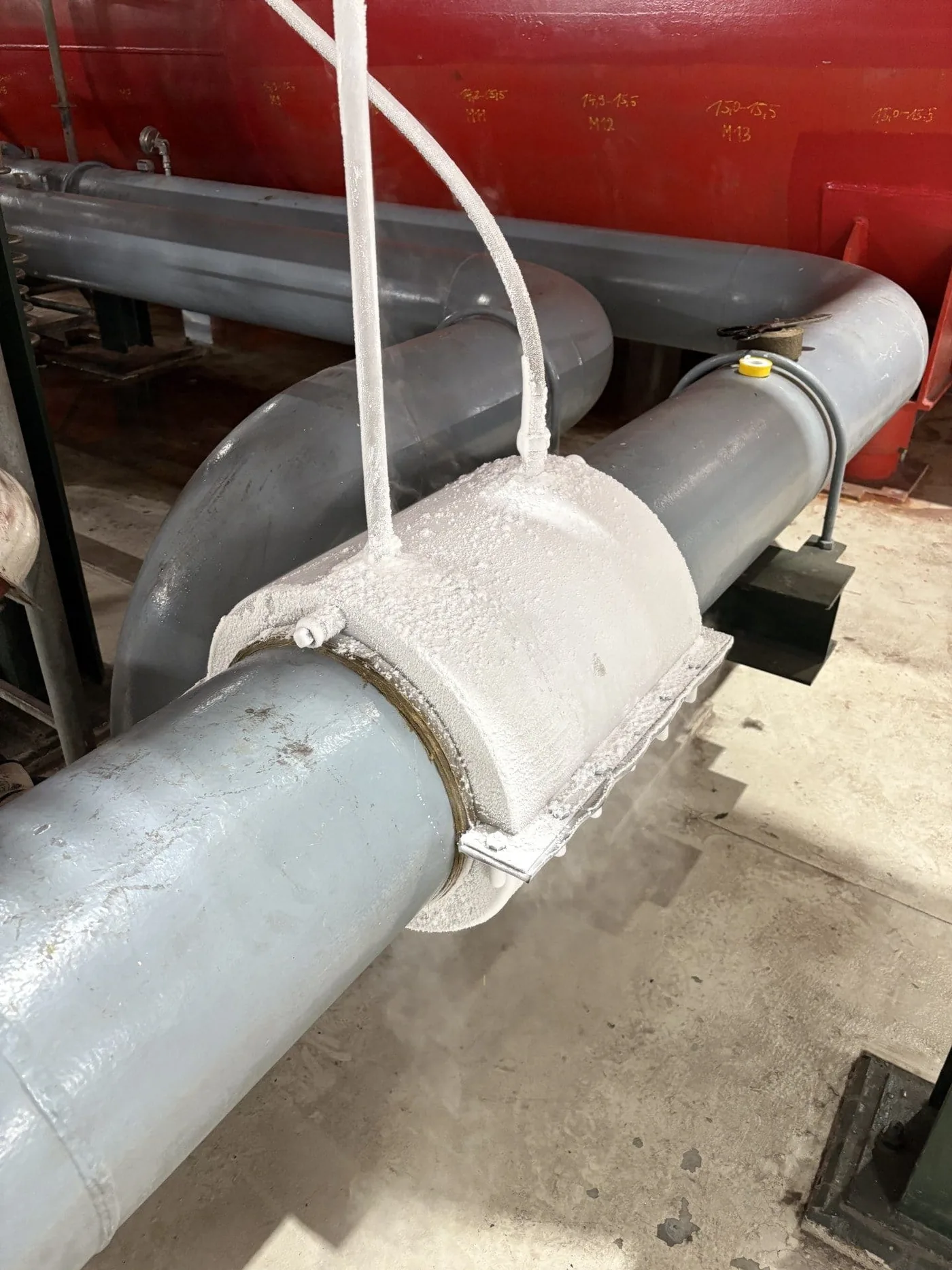
Pipe freezing is a method of temporarily isolating a pipeline without any intervention in the pipe itself: a freeze jacket is placed around the pipe section and charged with liquid nitrogen (−196 °C) or CO₂. The stationary medium inside the pipe freezes into a load-bearing ice plug that seals the line — the plant behind it can keep running, and the line needs neither draining nor flushing. After the work is completed, the plug is thawed in a controlled manner; no residues or changes to the pipe remain.
How a freeze operation works
- ▸1. Advance check: material suitability and condition of the line are verified — on request including non-destructive testing (NDT) of the freeze position before starting.
- ▸2. Preparation: remove insulation at the freeze position, switch off trace heating; the line must be completely filled and vented, the medium stationary (medium temperature ideally below 20 °C).
- ▸3. Freezing: mount the freeze jacket (on one or both sides of the work area), controlled LN₂ charging; plug formation is continuously monitored via temperature sensors on the pipe surface, and the LN₂ supply is designed with redundancy.
- ▸4. Work: valve replacement, repair, new connection or pressure test — the plug holds as long as cooling continues (over several days if required).
- ▸5. Thawing: controlled and documented; the plant returns to operation without flushing or refilling.
Technical data and application limits
| Parameter | Value |
|---|---|
| Coolant | liquid nitrogen (N₂, −196 °C); CO₂ (−78 °C) for small diameters |
| Pipe sizes | industry-typical DN 15 to approx. DN 400 as standard, larger on a project basis |
| Permissible differential pressure at the plug | depending on application and pipe size (designed on a project basis) |
| Suitable media | water and aqueous solutions, glycol mixtures (concentration-dependent), many oils |
| Requirements | medium stationary, line completely filled/vented, medium temperature ≤ approx. 50 °C, free pipe section approx. 3 × DN |
| Materials | material suitability is verified in advance; we match cooling and procedure to the pipe material (low-temperature-suitable materials, e.g. austenitic CrNi steels) |
| Plug formation time | typically 30 minutes to a few hours, depending on DN and medium |
Safety
Nitrogen displaces oxygen — which is why we work with a ventilation concept and O₂ monitoring, mandatory indoors. The freeze position is never left unattended, hot work keeps its distance from the plug, and the team wears cryogenic PPE. These points are defined in our documented risk assessment (TRA Pipe Freezing Nitrogen); the scope of our ISO 9001, ISO 45001 and VCA-P certificates explicitly includes pipe freezing.
Pipe freezing or hot tapping / line stop?
Pipe freezing requires no intervention in the pipe wall at all: no drilling, no chips, no fittings left behind — but it needs a freezable, stationary medium and a low-temperature-suitable material. If a flowing line must be isolated, or the medium is a gas or not freezable, line stopping with a preceding hot tap is the method of choice — HSOS offers both. We advise neutrally on which method is safe and economical for your case.
Reference project
For a major refinery in Rotterdam, HSOS carried out four simultaneous freezes on two 8″ lines — with a specially developed "Customized Double Pipe Freeze Jacket", including hot taps for pressure gauge and relief valve. Crew: one freeze supervisor and three technicians.
Frequently Asked Questions
For which pipe dimensions does pipe freezing work?
From small instrument tubing to large process lines — standard jobs range roughly from DN 15 to DN 400; larger diameters are handled on a project basis with adapted freeze chambers (reference: 8″ double freeze in a Rotterdam refinery). The decisive factors are medium, material and space at the freeze position.
Which media/liquids are suitable?
Water freezes best; aqueous solutions, glycol mixtures (depending on concentration) and many oils are also suitable. The precondition is always: the medium is stationary and the line is completely filled at the freeze position. Gases and flowing media cannot be frozen — that is where line stopping comes in.
Is there a risk of the plug damaging the pipe?
No, generally not. If the pressure the plug builds up exceeds the internal pressure in the line, the plug expands axially along the pipe — pushing lengthwise rather than loading the pipe wall radially.
How does pipe freezing differ from hot tapping?
In hot tapping the line is drilled under pressure to create a branch or (with a line stop) to isolate it — a permanent intervention with a fitting. Pipe freezing isolates the line from the outside: no drilling, no chips; after thawing, the line is unchanged. In return it is limited to freezable, stationary media.